
My American Heritage
by Allen C. Guelzo

The following essay originally appeared in edited form in National Review on July 3, 2026, under the title “Our American Heritage.”
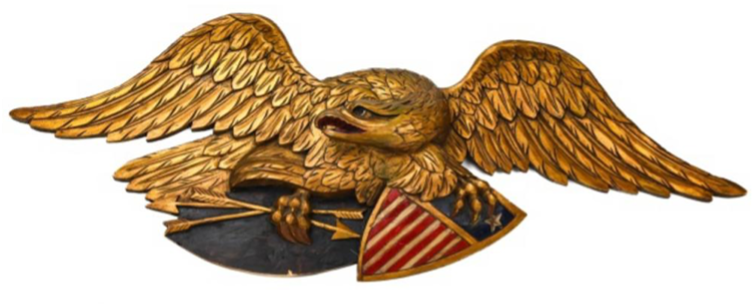
Growing up in the early Sixties, nothing captured my imagination more than a history magazine: American Heritage. Other kids buried their noses in Mad and Batman. I was entranced by American Heritage’s golden spread-eagle logo, the hardbound magazine covers, the full-color reproductions of historic paintings, and the “junior” book histories. And the heritage it embodied was what the magazine’s founding editor, Bruce Catton, called “that great, unfinished, and illogically inspiring story of the American people doing and being and becoming.”1
A lifetime later, we are playing with a new definition of heritage. If I access a Substack newsletter that flies under the banner ‘Heritage Americans,’ I learn that heritage now means being a lineal descendant of “Protestant, English-speaking, Northwestern Europeans, primarily English, who birthed the American nation, starting from Jamestown in 1607 to approximately the 1870s.”2 Another website insists that being a ‘heritage American’ is best understood as “involving seven inheritances: the English language, Christianity, self-government, Christian government, liberty, equality under the law, and relationship with the physical land.”3
And whether he clearly intended this or not, Vice-President Vance almost made this definition of heritage official when he explained last July that “America is not just an idea,” and that being an American is not “purely agreement with the creedal principles of America.” It’s “a particular place with a particular people and a particular set of beliefs and way of life.”4
Somewhere along the path of heritage that stretches from Catton to yesterday, I was put off the train, sent to the back of the bus, and shown the other side of Emma Lazarus’ golden door. And why? Because I fit none of the new definitions of heritage.
My great-grandparents arrived in America in the 1880s, too late to count by the new heritage reckoning. One was an Irish Catholic twenty-year-old who clutched in her hand a steerage ticket for the White Star liner Germanic (and who lived long enough for me to remember her); another was a Swedish aristocrat’s son who had had his fill of kings and preferred to make his living as a terra-cotta molder in a place where liberty would be his children’s birthright; another was a Jewish tailor who arrived in Chicago, fresh from a small town west of Munich named Dachau.
The finest thing they saw in life was the boat that brought them to America. That is my American heritage, and in the name of 250 years of American independence, I am not willing to see it eclipsed.
No one had better claim to the kind of heritage the Substacks are promoting than Abraham Lincoln. His most distant ancestors had arrived at the peak of New England’s “Great Migration” of the 1630s; his grandfather had fought in the Revolution, and several very-distant relatives had held office in Massachusetts politics.
But it never occurred to Lincoln to define himself as an American in any other terms but those of 1776 and the principles of the Declaration of Independence. The Revolution, he said in 1861, involved “something even more than National Independence … something that held out a great promise to all the people of the world to all time to come.”5 That “something” was the Declaration’s announcement that all men are created equal and are endowed by their Creator with certain unalienable rights, and that among these are life, liberty and the pursuit of happiness. Lincoln did not enter his plea against tyranny by appealing to English common law, to purple mountain majesties or to seventeenth-century bloodlines, but to certain inherent principles which were hardwired into every human being and a “proposition” to which Americans then “dedicated” themselves.
Lincoln was fully aware how much the landscape of America had been changed by the crush of immigration in his day. “Perhaps half our people,” he said in 1858, “are not descendants at all” of the Revolutionary generation; “they are men who have come from Europe – German, Irish, French and Scandinavian.” However, they have only to take up the Declaration, and there they find
