
America’s First Constitution – Part Two
by Allen C. Guelzo

This is the second installment of a two-part essay on the Articles of Confederation. Part One was posted on July 24, 2026.
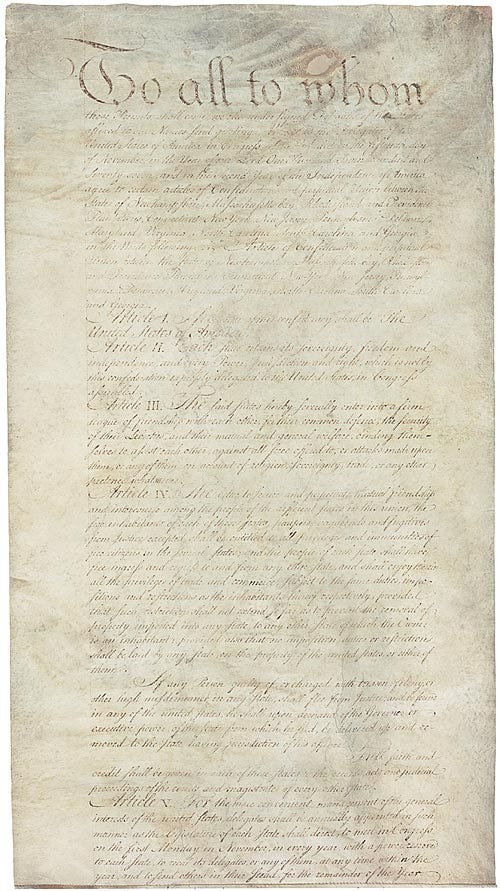
The debates over the Articles would resume in Congress in April, 1777, and then again in October (when the British threat forced Congress to shift its meeting-place to York, Pennsylvania), and with the issue of a possible French alliance now in play, Congress suddenly moved into high gear to solve three issues.
The first concerned representation in Congress: how should each of the thirteen states be represented? Equally, by each casting one vote in the Confederation Congress? or proportionately, according to each state’s size, or even according to each state’s wealth (as measured by the value of taxable land)? On one level, this was obviously a debate between larger landed and wealthier states as opposed to smaller, commercial states, since equal representation would give a small state like Connecticut equal standing in Congress with large, agricultural states like Virginia. Equal representation had been the rule in the Continental Congress, and Connecticut obviously would conclude that this was an idea worthy of extending to the Confederation. It would also restrain any temptation to large states like Virginia to bully the smaller ones in Congress. Government “is commonly in the hands of the vilest men,” warned one Rhode Island member of Congress. “How restless are many of our rulers to engross more power?”1
Virginia, naturally, disagreed: Connecticut would take advantage of equal standing to pass legislation which Virginia stood only limited chances of opposing in Congress, legislation which could pick Virginia’s voluminous pockets much more deeply than anything Connecticut would have to endure. Virginia, being both more populous and more economically powerful, deserved to have more say in policies which might affect the Old Dominion’s people and power.
On another level, however, the debate over representation was also about who, exactly, the delegates who would sit in the Confederation Congress actually represented.2 If the delegates represented their states (and thus the wishes of their state governments), then each ought to have only one vote, and so there should be just thirteen votes in the whole Congress. But if the delegates were said to represent the population of their states, and not just the interests of the state governments, then there ought to be proportionally as many voting delegates from each state as there were people.
But time was no longer a luxury for Congress. On October 7, 1777, the small states successfully staved-off the proportional-representation advocates, and the plan for equal representation was carried over from the Continental Congress.
The debate over representation led irresistibly to a debate about taxation (although the Articles would be reluctant to even use the word tax), and Congress’s power to pay its bills. If each state was, large or small, to have only one equal vote, then wasn’t it logical to insist that the “charges” to be paid should be calculated on a similarly equal basis, with Connecticut and Virginia paying the same to a “common treasury”? Surprisingly, the original Dickinson draft of the Articles assessed each state on its population’s size, so that Virginia, with a substantially larger population than Connecticut, would pay a greater share, even if it received only the same vote, and so got the same management of affairs in Congress, as Connecticut. What struck the Virginians even more roughly was that the Dickinson draft proposed to count Virginia’s slave population in calculating the tax bill – Virginia would not only pay more, but would pay more on the basis of a population it enslaved.
The Virginians countered by proposing that “charges” be calculated, not on population, but on wealth, as calculated by the value of landed property. Given Virginia’s greater land size, this might seem at first a still-attractive notion to Connecticut. But the truth was that Connecticut’s land had been more thickly and intensively settled than Virginia’s, and thus was worth more, acre-for-acre. Connecticut, as a result, would see itself paying more such taxes than Virginia, despite its smaller size. But in this case, when the matter was finally put to a vote in Congress, the Dickinson draft was amended to levy contributions “in proportion to the value of all land within each state” (Article Eight). What would turn out to be more toxic was the failure of the Articles to specify an enforcement mechanism for ensuring the payment of any assessments on the states. Momentous as this decision was, it took Congress only five days to settle it.
The discussion of funding the government, in turn, re-awakened the quarrels over control of the lands to the West, across the Appalachians. Some states, like (again) Virginia and Connecticut had never had their western boundaries specified in their charters, and that allowed them to make the kinds of claims in the West that we saw in Part One. The British government had solved this in 1763 by fixing the Appalachians as the westward limit of colonial expansion, but Britain had never been successful at enforcing this restraint, and after 1776, Virginia began scrambling in earnest for more western territory.
The “boundaried” states, like New Jersey, Delaware, Rhode Island and Maryland, now appealed to Congress to limit westward expansion, or at least to guarantee a fair division of the western lands. John Dickinson failed to include in his draft any description of a regulative power that would enable Congress to impose a limit, but the ninth of the Articles strongly implied that there were western lands over which no state had control, only Congress. “No colony has a Right to go to the S[outh] Sea,” declared Samuel Chase of Maryland. “They never had – they can’t have. It would not be safe to the rest. It would be destructive to her Sisters, and to herself.”3
But it was exactly that kind of restriction which had helped trigger Virginia’s move toward independence in the first place. One anxious Marylander warned that “the bare mentioning of this subject rouses Virginia.”4 But time was of the essence, and on October 15th, Congress rejected provisions for overseeing the western lands or limiting state claims there. But the debate, in fact, would continue for the next four years.
Congress managed to finish work on the Articles as early as November 15, 1777, and a revised and substantially overhauled draft of the Articles, describing the new confederacy as the “United States of America,” was sent out to the various state assemblies for ratification. (See the text of the Articles: https://www.archives.gov/milestone-documents/articles-of-confederation). But there, the debates over a central government took on new life. In some cases, the state legislatures took it on themselves to re-write the Articles so dramatically that the states became virtually independent of Congress. In North Carolina, the legislature proposed ratifying only selected articles, and left aside “what may very materially affect the internal interests and Sovereign Independence” of North Carolina “until there shall be full time and leisure for materially and deliberately considering the same.” South Carolina approved the Articles, but only with twenty-one amendments; others took no real action at all, and as late as April of 1778, four states had still failed to ratify the Articles.5
Especially stubborn were Maryland, Delaware and New Jersey, still dissatisfied over the western lands question. New Jersey finally conceded in November, 1778, and Delaware ratified, still protesting, in January, 1779. But Maryland folded its arms and resisted until the summer of 1780, when a British offensive into neighboring Virginia – and the polite urging of France’s diplomatic agent, the Chevalier de la Luzerne -- frightened enough of the Marylanders to agree to allow Congress to oversee western land claims. In September, 1780, Congress called on states claiming western extension to surrender those demands in order to get the ratification holdouts in line. Connecticut then agreed to surrender its western demands, and on January 2, 1781, the Virginia legislature also passed an act of cession which yielded jurisdiction over most (but not all) of its claims to Congress.
With that, Maryland was finally satisfied, and ratified the Articles of Confederation on February 2, 1781, and a month later the Articles were officially declared to be in effect. “By a Signal given at the State House [in Philadelphia] the Completion of this grand Union and Confederation was announced by Firing thirteen cannon on the Hill,” wrote Thomas Rodney, a member of Congress from Delaware (and the son of Caesar Rodney, a signer of the Declaration of Independence) in his diary.
At Two O’Clock the Members of Congress and a great number of Gentlemen waited on the President of Congress [Samuel Huntington of Connecticut] to Congratulate him on this occasion; and partook of a Collation prepaired at his House for that purpose. In the evening there was a grand exhibition of fireworks at the State House, and also on board [John] Paul Jones’ Frigate in the Harbour, and all the vessels in the Harbour were Decorated and illuminated on this occasion and great joy appeared in every Countenance….6
With the ratification, the Continental Congress ceased its legal existence and became the new Confederation Congress. But it was a Congress with only the most halting powers, and the onlooking European empires now shook their heads in glee and wondered how long it would take before the whole experiment collapsed in on itself.
David Howell, in George Van Cleve, We Have Not a Government: The Articles of Confederation and the Road to the Constitution (Chicago: University of Chicago Press, 2017), 30.
Each state was represented by a “delegation,” which was supposed to contain not less “than two, nor … more than seven Members” (Article Four), but the delegation would only cast one vote.
Chase, in Lynn Montross, The Reluctant Rebels: The Story of the Continental Congress (New York: Harper & Row, 1950), 186. See Article Nine: “All controversies concerning the private right of soil claimed under different grants of two or more states, whose jurisdictions as they may respect such lands, and the states which passed such grants are adjusted, the said grants or either of them being at the same time claimed to have originated antecedent to such settlement of jurisdiction, shall, on the petition of either party to the congress of the united states, be finally determined, as near as may be, in the same manner as is before prescribed for deciding disputes respecting territorial jurisdiction between different states.”
Jensen, Articles of Confederation, 191.
A. Maclaine, in The Colonial Records of North Carolina, ed. W. Clark (Winston: M.&J. Stewart, 1896), 12:229.
Rodney, in Montross, The Reluctant Rebels, 310. See also The Pennsylvania Journal, or Weekly Advertiser (March 7, 1781), Poulson’s American Daily Advertiser (March 3, 1781), and The Pennsylvania Evening Post (March 5, 1781).